Exhibition — KSCA “The Art of Adaptation: Culture Changes Everywhere”
Kandos School of Cultural Adaptation (KSCA) have recently held a 10 year anniversary retrospective exhibition at the Manly Art Gallery & Museum (MAG&M), curated by Ben Rak and Katherine Roberts as part of the gallery’s Collective for Environmental Art & Design program. The exhibition has since gone on tour to the Blue Mountains Cultural Centre, where it will be up until August 2nd.
Nina Stromqvist has written a really sharp review of the exhibit that wonderfully captures the ethos, aims and tone of the exhibit and what KSCA has been up to this last decade. A quote from Nina:
And, if you’ll indulge me, another quote:
An artist, a farmer and a scientist walk into a bar..., a newspaper edited by Laura Fisher, Lucas Ihlein and myself in 2021, is included as part of the works, alongside a brilliant set of prefigurative experiments and microcosmic assemblages. Thank you to MAG&M for their invitation to look back on 10 years of KSCA, and the whole KSCA crew for pulling this show together. The exhibition catalogue can be accessed here for those interested in learning more about the contributing artists and KSCA.
The participating artists are: Diego Bonetto, Laura Fisher, Lucas Ihlein, Ian Milliss, Georgina Pollard, Imogen Semmler, Peter Swain, Leanne Thompson, Erika Watson, Kim Williams, Alex Wisser and Vickie Zhang. Contributing members to KSCA over the past decade include Gilbert Grace, Eloise Lindeback, Sarah Breen Lovett, Christine MacMillan, Emmanuela Prigioni and Kelly Reiffer.
Kandos School of Cultural Adaptation (KSCA) have recently held a 10 year anniversary retrospective exhibition at the Manly Art Gallery & Museum (MAG&M), curated by Ben Rak and Katherine Roberts as part of the gallery’s Collective for Environmental Art & Design program. The exhibition has since gone on tour to the Blue Mountains Cultural Centre, where it will be up until August 2nd.
Nina Stromqvist has written a really sharp review of the exhibit that wonderfully captures the ethos, aims and tone of the exhibit and what KSCA has been up to this last decade. A quote from Nina:
"I want to resist the familiar claim that exhibitions such as these reveal and make visible a network of cultures that already exist. The language of revelation keeps the attention fixed on what the gallery can recognise and interpret, and I would argue that the KSCA artists and their collaborators aren’t particularly motivated by "raising awareness" or demystifying the conditions that produce a crisis. Rather, they are more invested in prefigurative experiments and assembling resources for microcosmic futures.
And, if you’ll indulge me, another quote:
“The exhibition’s greatest achievement is that it resists reducing KSCA to a set of outcomes or retrospective evidence of something that happened elsewhere. Instead, it retains something of the joyful experimentation that has long characterised the collective’s activities. While the exhibition offers a partial glimpse into a practice that remains grounded in place and the work of cultural adaptation, it also trains our attention onto an underacknowledged lineage of artists, including Vivienne Binns and other feminist pioneers, whose work has long moved between community and institution, expanding our understanding of where art happens and who it is for. "
An artist, a farmer and a scientist walk into a bar..., a newspaper edited by Laura Fisher, Lucas Ihlein and myself in 2021, is included as part of the works, alongside a brilliant set of prefigurative experiments and microcosmic assemblages. Thank you to MAG&M for their invitation to look back on 10 years of KSCA, and the whole KSCA crew for pulling this show together. The exhibition catalogue can be accessed here for those interested in learning more about the contributing artists and KSCA.
The participating artists are: Diego Bonetto, Laura Fisher, Lucas Ihlein, Ian Milliss, Georgina Pollard, Imogen Semmler, Peter Swain, Leanne Thompson, Erika Watson, Kim Williams, Alex Wisser and Vickie Zhang. Contributing members to KSCA over the past decade include Gilbert Grace, Eloise Lindeback, Sarah Breen Lovett, Christine MacMillan, Emmanuela Prigioni and Kelly Reiffer.
07/2026
![]()
An artist, a farmer and a scientist walk into a bar... installed at Blue Mountains Cultural Centre, Kandos School of Cultural Adaptation. Photo: Nina Stromqvist.

An artist, a farmer and a scientist walk into a bar... installed at Blue Mountains Cultural Centre, Kandos School of Cultural Adaptation. Photo: Nina Stromqvist.
Forthcoming collection — “Concepts for Cultural Geography” and new CG(U)LE website
Another year, another call! Ben and I are excited about the next collection in the works to be published by Cultural Geography (Un)limited Editions, called Concepts for Cultural Geography.
Submissions have just closed, and we’re delighted to have had over 130 entries sent in. The summer will be spent combing through these, and thinking about how and what this comingling of concepts adds to the rich world of cultural geography.
Relatedly, we’ve finally got a website for the publisher up and running. We’re appreciative to the University of Bristol for giving us some seed funding to get the platform up and running. It’s still a work-in-progress, but it’s nice to have a little plot of our own to tend to, and hopefully you will see things grow over the next months...
Another year, another call! Ben and I are excited about the next collection in the works to be published by Cultural Geography (Un)limited Editions, called Concepts for Cultural Geography.
Submissions have just closed, and we’re delighted to have had over 130 entries sent in. The summer will be spent combing through these, and thinking about how and what this comingling of concepts adds to the rich world of cultural geography.
Relatedly, we’ve finally got a website for the publisher up and running. We’re appreciative to the University of Bristol for giving us some seed funding to get the platform up and running. It’s still a work-in-progress, but it’s nice to have a little plot of our own to tend to, and hopefully you will see things grow over the next months...

New paper — “Ambivalent threads of repair: transmitting, translating and transforming Yao embroidery at an ethnic boarding school in China”
My colleagues at Guangzhou University and I have a short new article out in the Cultural Geographies in Practice section of cultural geographies.
Led by my fantastic colleague Lei Wei, it draws on research that Lei has been leading into ethnic minority folk and craft practices in China. It draws on a particular thread of this fieldwork that took place in a primary school where traditional craft practices are being revived and reinvented in the classroom.
We argue that the school is not simply preserving these practices but also reshaping them – imparting new relations and functions, including commodification and codification into state-led institutions concerned with cultivating ideal citizen-subjects. Without appealing to celebratory narratives or idealised repair, we reflect in this article on the transmission of craft practices at the intersection of loss and transformation.
My colleagues at Guangzhou University and I have a short new article out in the Cultural Geographies in Practice section of cultural geographies.
Led by my fantastic colleague Lei Wei, it draws on research that Lei has been leading into ethnic minority folk and craft practices in China. It draws on a particular thread of this fieldwork that took place in a primary school where traditional craft practices are being revived and reinvented in the classroom.
We argue that the school is not simply preserving these practices but also reshaping them – imparting new relations and functions, including commodification and codification into state-led institutions concerned with cultivating ideal citizen-subjects. Without appealing to celebratory narratives or idealised repair, we reflect in this article on the transmission of craft practices at the intersection of loss and transformation.
02/2026
![]()
Photographs by Teng Zhou.
Citation: Wei, L., Zhang, V., Zhou, T., & Zhu, H. (2026). Ambivalent threads of repair: transmitting, translating and transforming Yao embroidery at an ethnic boarding school in China. cultural geographies, 14744740261418698. doi:10.1177/14744740261418698

Photographs by Teng Zhou.
Citation: Wei, L., Zhang, V., Zhou, T., & Zhu, H. (2026). Ambivalent threads of repair: transmitting, translating and transforming Yao embroidery at an ethnic boarding school in China. cultural geographies, 14744740261418698. doi:10.1177/14744740261418698
Compilation — “The Promise of Cultural Geography”
What somehow has come to feel like the main thing I’ve been working on throughout 2025 has been a side project with Ben Anderson up in Durham called The Promise of Cultural Geography, put out on our new publisher, Cultural Geography (Un)limited Editions, which we (frankly) established to put out the book (more on that in a future post...). The Promises project followed on from the 50th anniversary event for the RGS-IBG Social and Cultural Geography Research Group that I last wrote about, out of which Chris Philo and I wrote the Revisiting New Words, New Worlds correspondence piece.
To pair that ‘backwards-looking’ reflection, Ben and I hatched out a plan for a more ‘forwards-looking’ (or perhaps ‘stock-taking’) project, one that hoped to grasp at the multiplicty of the sub-discipline as it was being practiced in diverse corners and quarters of the world.
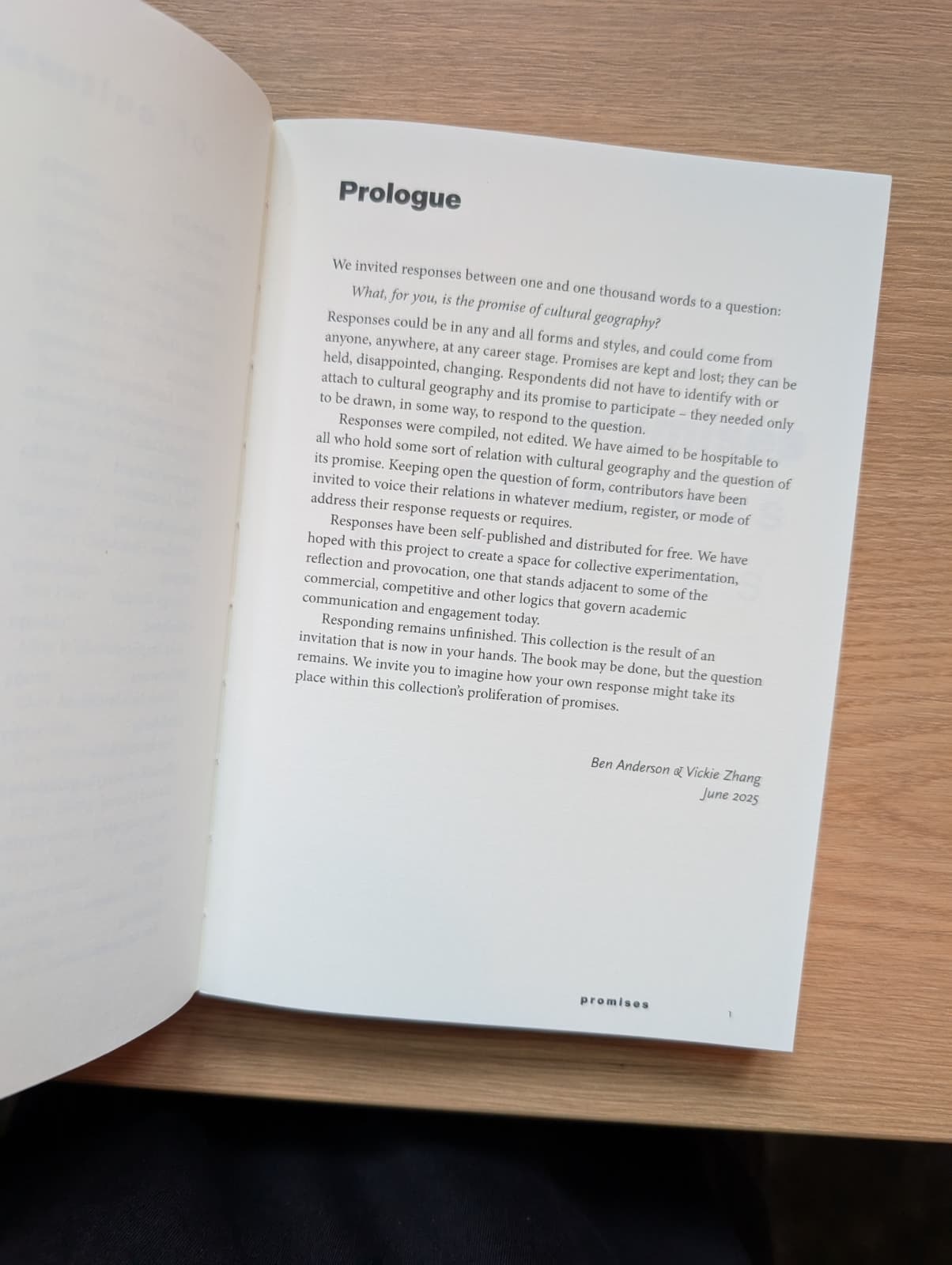
At the start of the year, we sent out an open call for single-word submissions of between 1 and 1,000 words, in any style or form, in response to the question ‘What, for you, is the promise of cultural geography?’
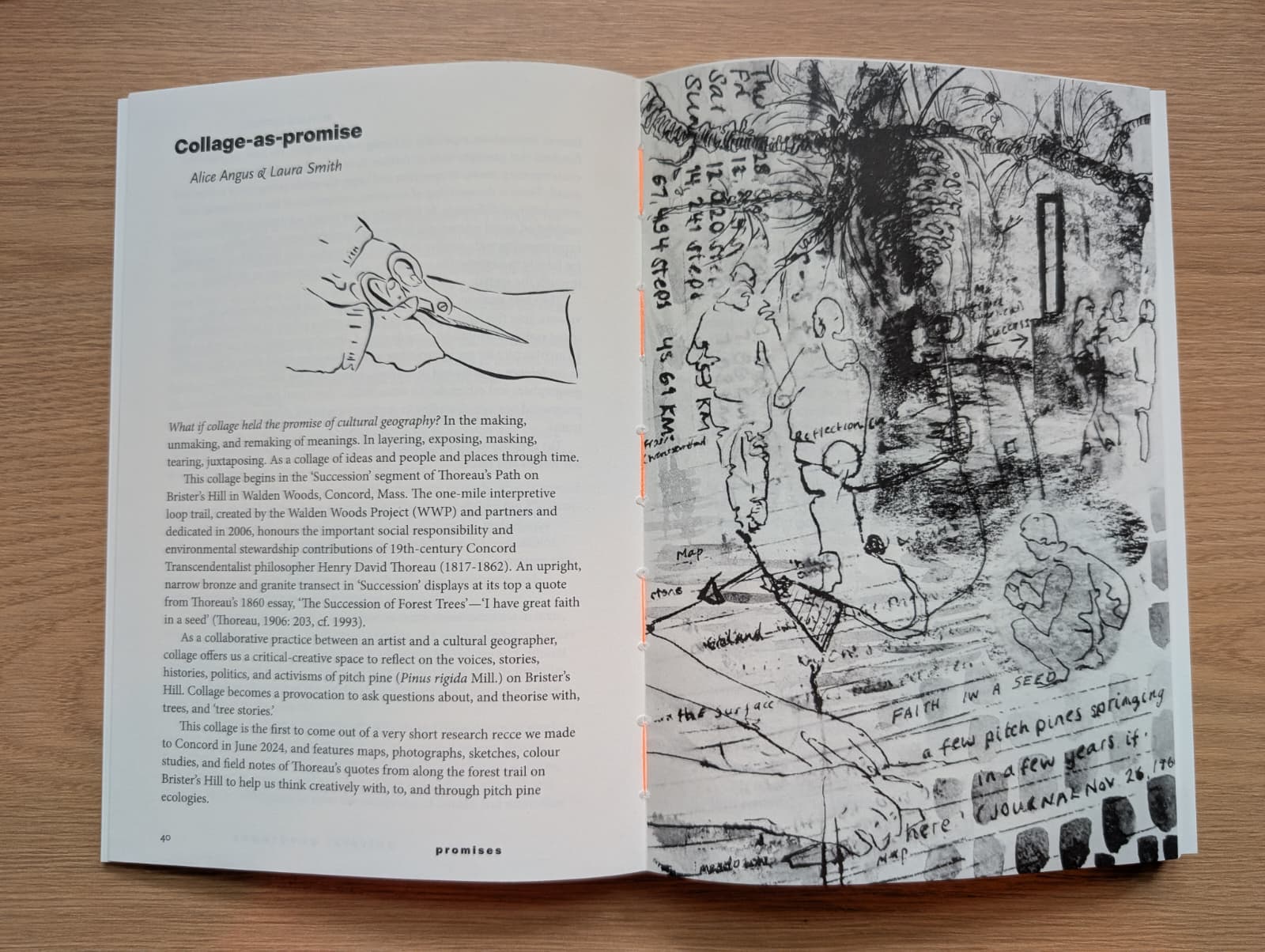
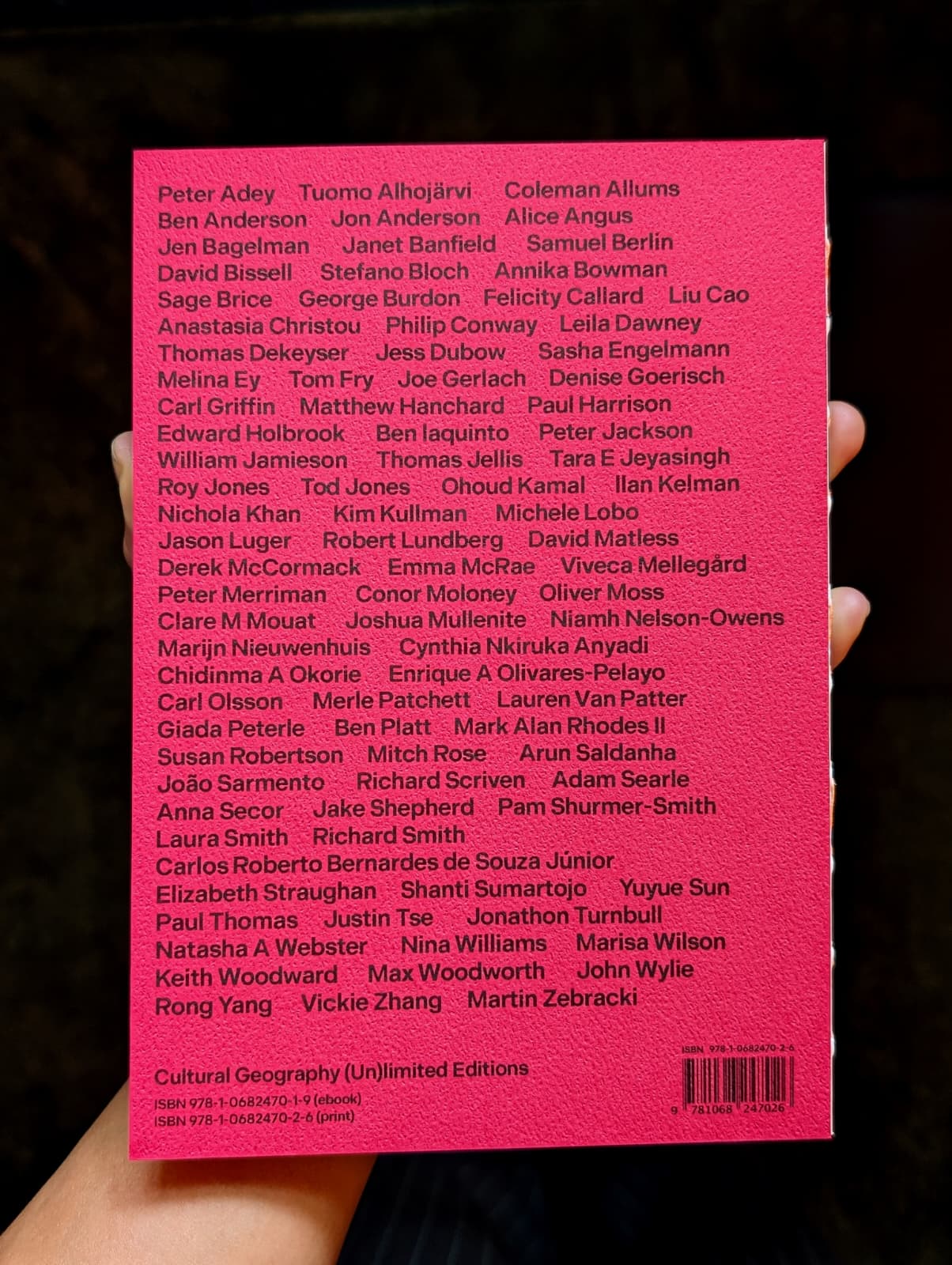
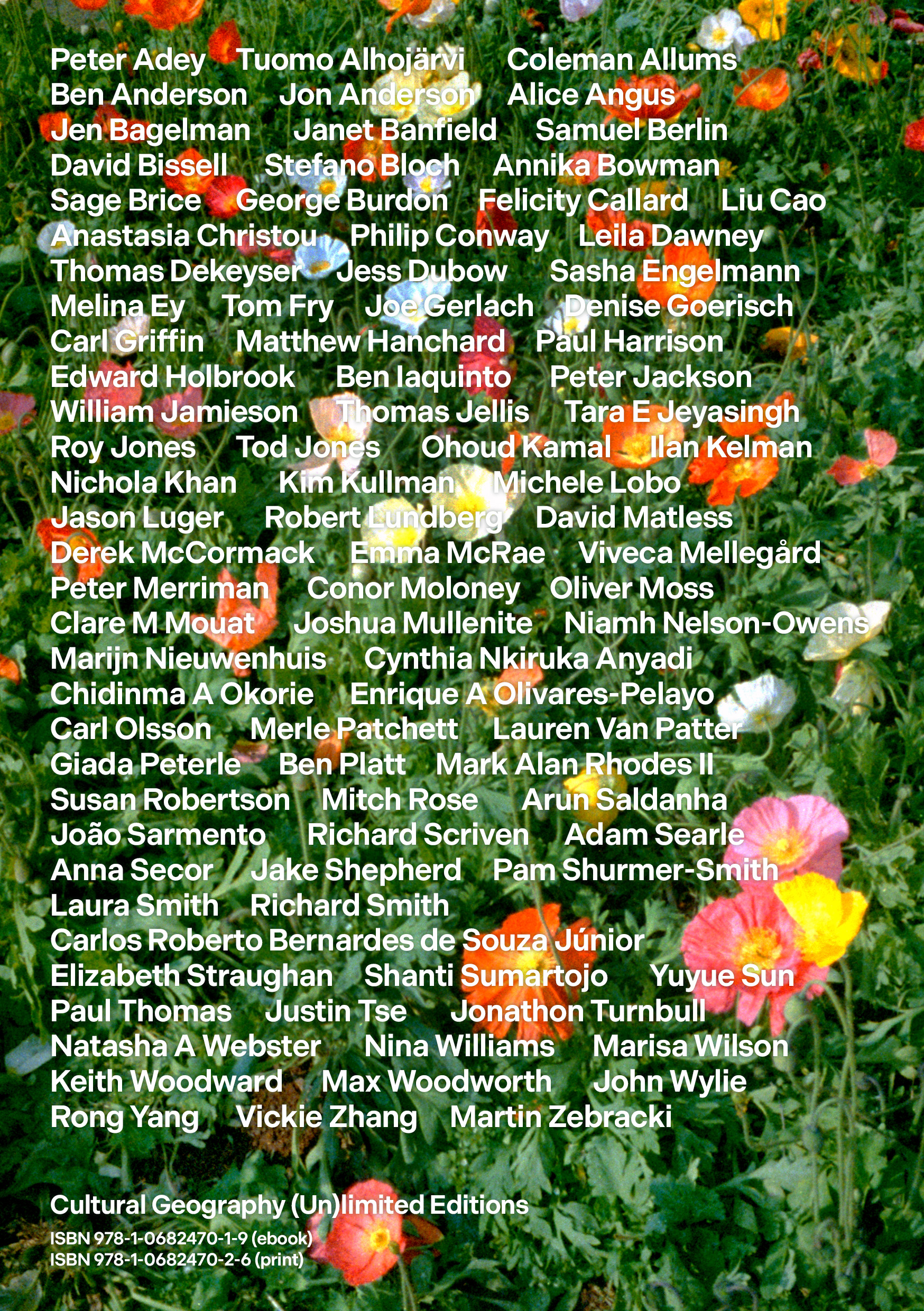
That call-out became Promises, a compilation of 86 single- and multi-authored entries responding to this perhaps rather engimatic question. (Indeed, I enjoyed chatting to my Chinese colleagues about how to translate the different meanings and connotations of the word ‘promise’, for which there is no single equivalent in Mandarin, including the sense of a pledge, an oath, a commitment, its directedness, futurity, uncertainty, even failure...)
In addition to the open-access digital copy (‘unlimited’), we also did a short run printed book (‘limited’), which we launched at the RGS-IBG Dialogues in Human Geography Discussion Forum ‘The future of cultural geography: promises and dreams’, alongside a stellar lineup of reflections and provocations by Adam Searle, Sasha Engelmann, Anna Secor, Leila Dawney and Chris Philo.
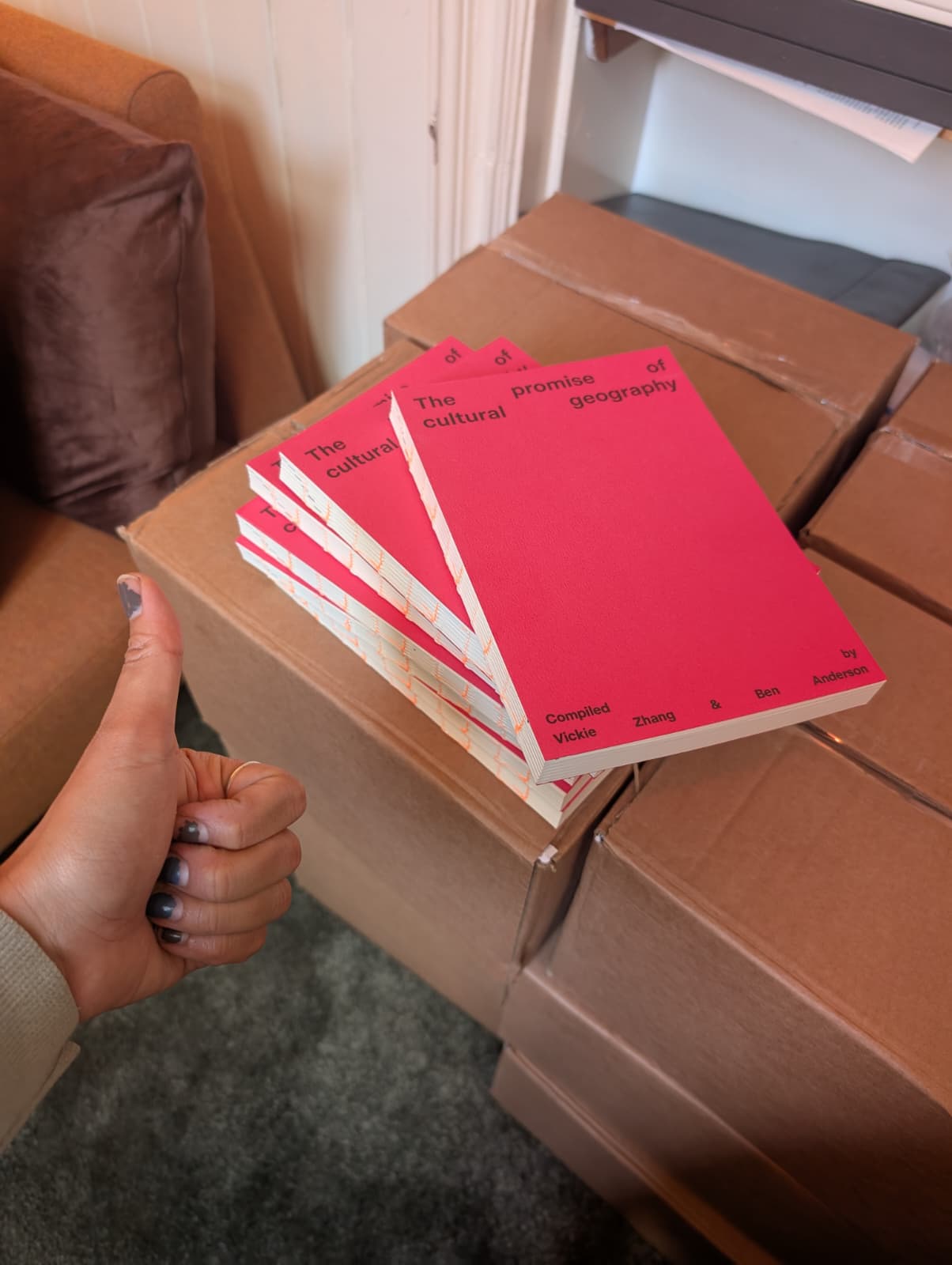
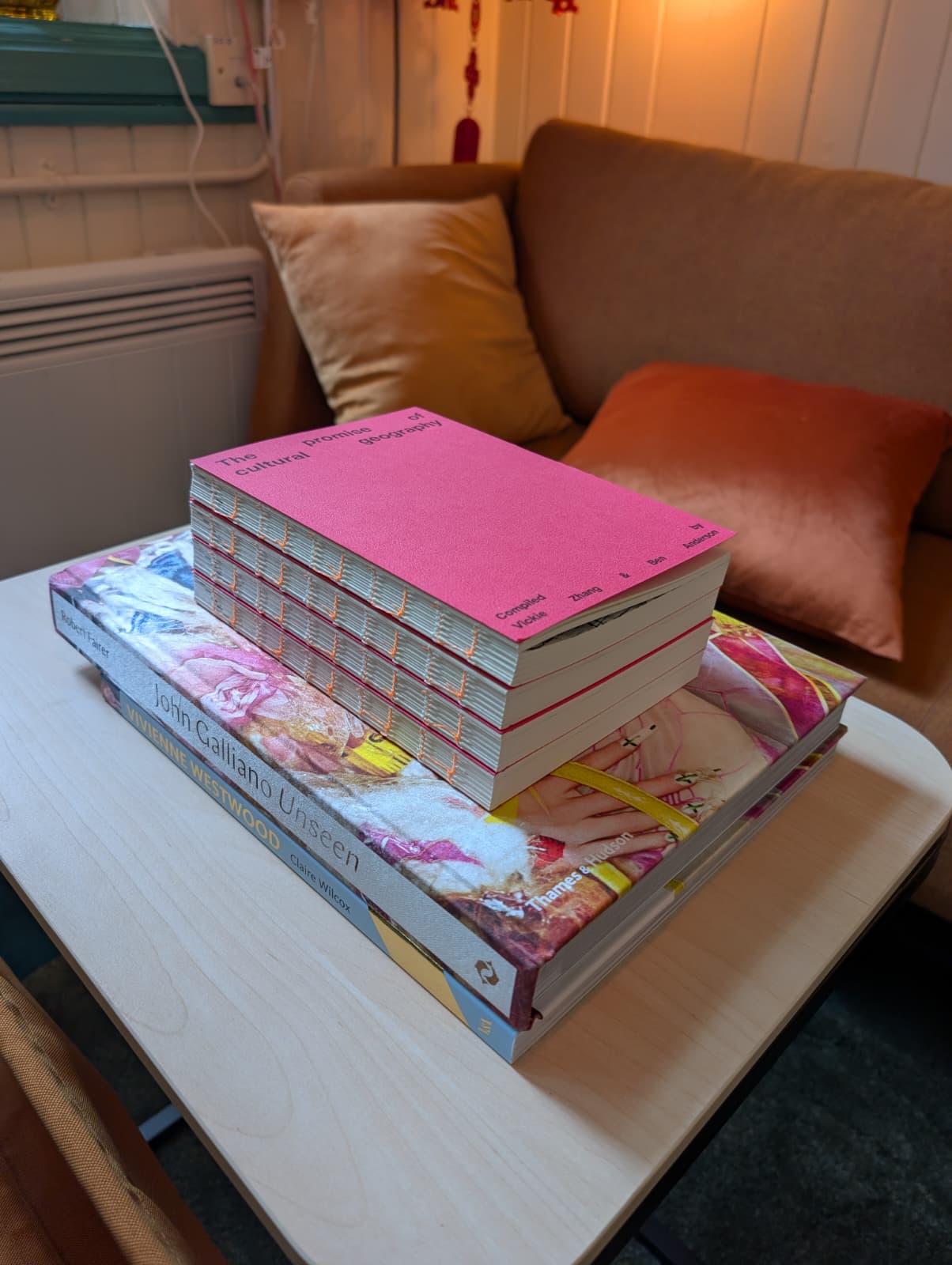
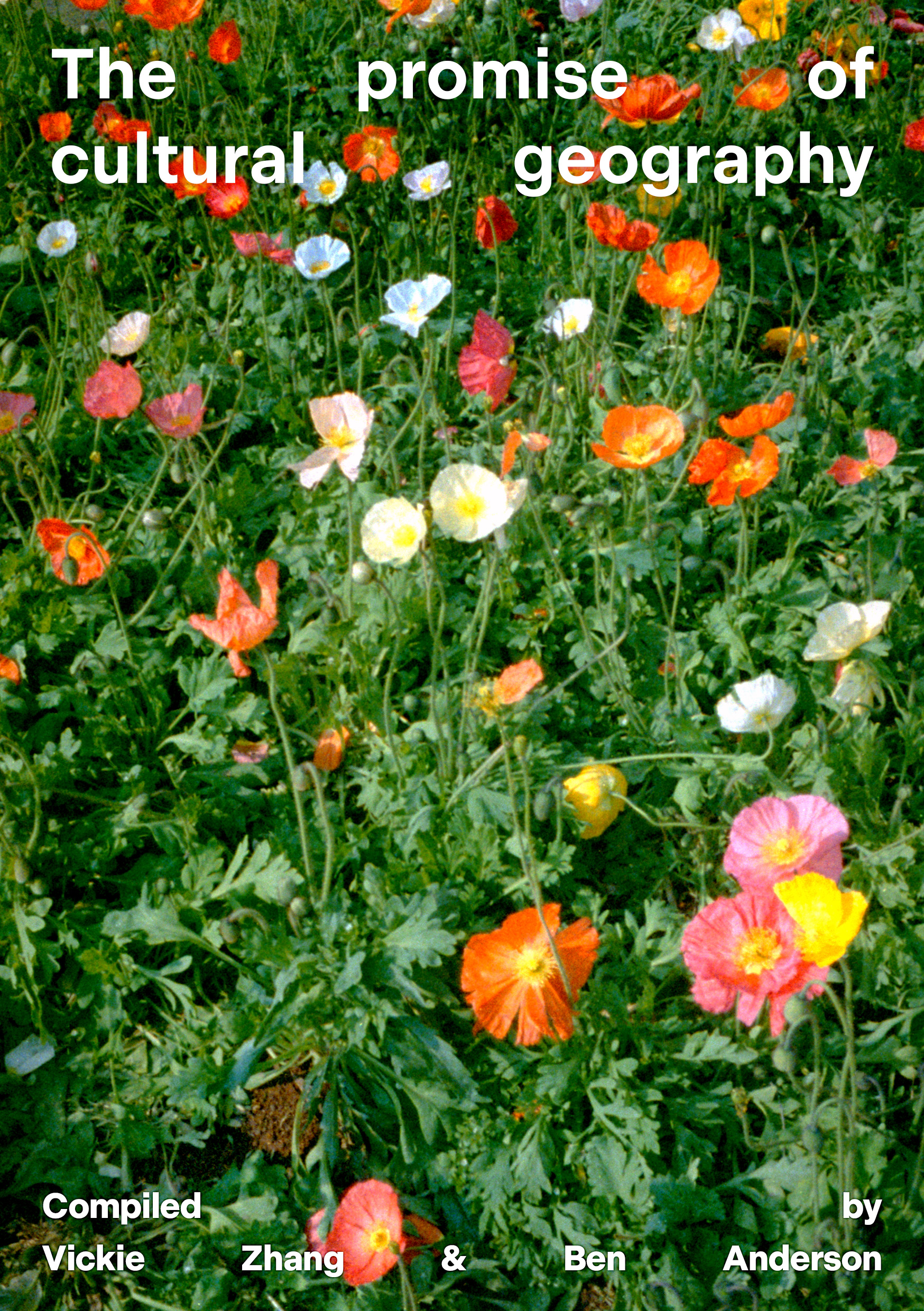
We were absolutely delighted to have the book beautifully printed by Gomer Press in Llandysul, Wales, with a embossed hot pink cover, textured cream paper, and a flurorescent-orange-stitched naked spine. Big props go to Merle Patchett for style tips on colours and textures for the print version.
Print copies are available for £10 + £3 postage worldwide — just get in touch with me by email if you’d like a copy. We managed to sell over 100 copies at the conference — a huge thanks goes to Catherine Souch and Sarah Evans of the RGS-IBG for taking care of the books at the registration desk.
If you’re interested in hearing more about the origins and unfoldings of the project, Ben and I recently joined a podcast about the project at the Channel, the podcast of the Institute of Asian Studies at the Universiteit Leiden. We were generously hosted by Ben Linder, who got in touch with us to learn more about the project. Ben asked some really banger questions, and it was an absolute delight to speak with him.
We are so grateful to every person who saw ‘promise’ in the Promise project. Ben and I are planning another collective project in the coming year, with much more planned for ‘cg(u)le’ — so stay tuned, and please, please consider sending something in! We’d love to have you.
What somehow has come to feel like the main thing I’ve been working on throughout 2025 has been a side project with Ben Anderson up in Durham called The Promise of Cultural Geography, put out on our new publisher, Cultural Geography (Un)limited Editions, which we (frankly) established to put out the book (more on that in a future post...). The Promises project followed on from the 50th anniversary event for the RGS-IBG Social and Cultural Geography Research Group that I last wrote about, out of which Chris Philo and I wrote the Revisiting New Words, New Worlds correspondence piece.
To pair that ‘backwards-looking’ reflection, Ben and I hatched out a plan for a more ‘forwards-looking’ (or perhaps ‘stock-taking’) project, one that hoped to grasp at the multiplicty of the sub-discipline as it was being practiced in diverse corners and quarters of the world.
At the start of the year, we sent out an open call for single-word submissions of between 1 and 1,000 words, in any style or form, in response to the question ‘What, for you, is the promise of cultural geography?’
That call-out became Promises, a compilation of 86 single- and multi-authored entries responding to this perhaps rather engimatic question. (Indeed, I enjoyed chatting to my Chinese colleagues about how to translate the different meanings and connotations of the word ‘promise’, for which there is no single equivalent in Mandarin, including the sense of a pledge, an oath, a commitment, its directedness, futurity, uncertainty, even failure...)
In addition to the open-access digital copy (‘unlimited’), we also did a short run printed book (‘limited’), which we launched at the RGS-IBG Dialogues in Human Geography Discussion Forum ‘The future of cultural geography: promises and dreams’, alongside a stellar lineup of reflections and provocations by Adam Searle, Sasha Engelmann, Anna Secor, Leila Dawney and Chris Philo.
We were absolutely delighted to have the book beautifully printed by Gomer Press in Llandysul, Wales, with a embossed hot pink cover, textured cream paper, and a flurorescent-orange-stitched naked spine. Big props go to Merle Patchett for style tips on colours and textures for the print version.
Print copies are available for £10 + £3 postage worldwide — just get in touch with me by email if you’d like a copy. We managed to sell over 100 copies at the conference — a huge thanks goes to Catherine Souch and Sarah Evans of the RGS-IBG for taking care of the books at the registration desk.
If you’re interested in hearing more about the origins and unfoldings of the project, Ben and I recently joined a podcast about the project at the Channel, the podcast of the Institute of Asian Studies at the Universiteit Leiden. We were generously hosted by Ben Linder, who got in touch with us to learn more about the project. Ben asked some really banger questions, and it was an absolute delight to speak with him.
We are so grateful to every person who saw ‘promise’ in the Promise project. Ben and I are planning another collective project in the coming year, with much more planned for ‘cg(u)le’ — so stay tuned, and please, please consider sending something in! We’d love to have you.
12/2025
![]()
![]()
Citation: Zhang, V., & Anderson, B. (2025). The promise of cultural geography. Cultural Geography (Un)limited Editions: Bristol and Durham. https://doi.org/10.71706/8dfd3ca0-0a6d-49ce-abdb-568a7ccbb807
Podcast about the project at ‘The Channel’, the podcast from IIAS at Leiden University: https://www.iias.asia/the-channel/promise-cultural-geography
![]()
![]()
![]()
![]()
![]()
Citation: Zhang, V., & Anderson, B. (2025). The promise of cultural geography. Cultural Geography (Un)limited Editions: Bristol and Durham. https://doi.org/10.71706/8dfd3ca0-0a6d-49ce-abdb-568a7ccbb807
Podcast about the project at ‘The Channel’, the podcast from IIAS at Leiden University: https://www.iias.asia/the-channel/promise-cultural-geography