
cultural geographer
affect, mobilities, work
negativity
economic + affective transitions
IAG Film Shorts
KSCA
SCGRG
Bristol
Scholar
Compilation — “The Promise of Cultural Geography”
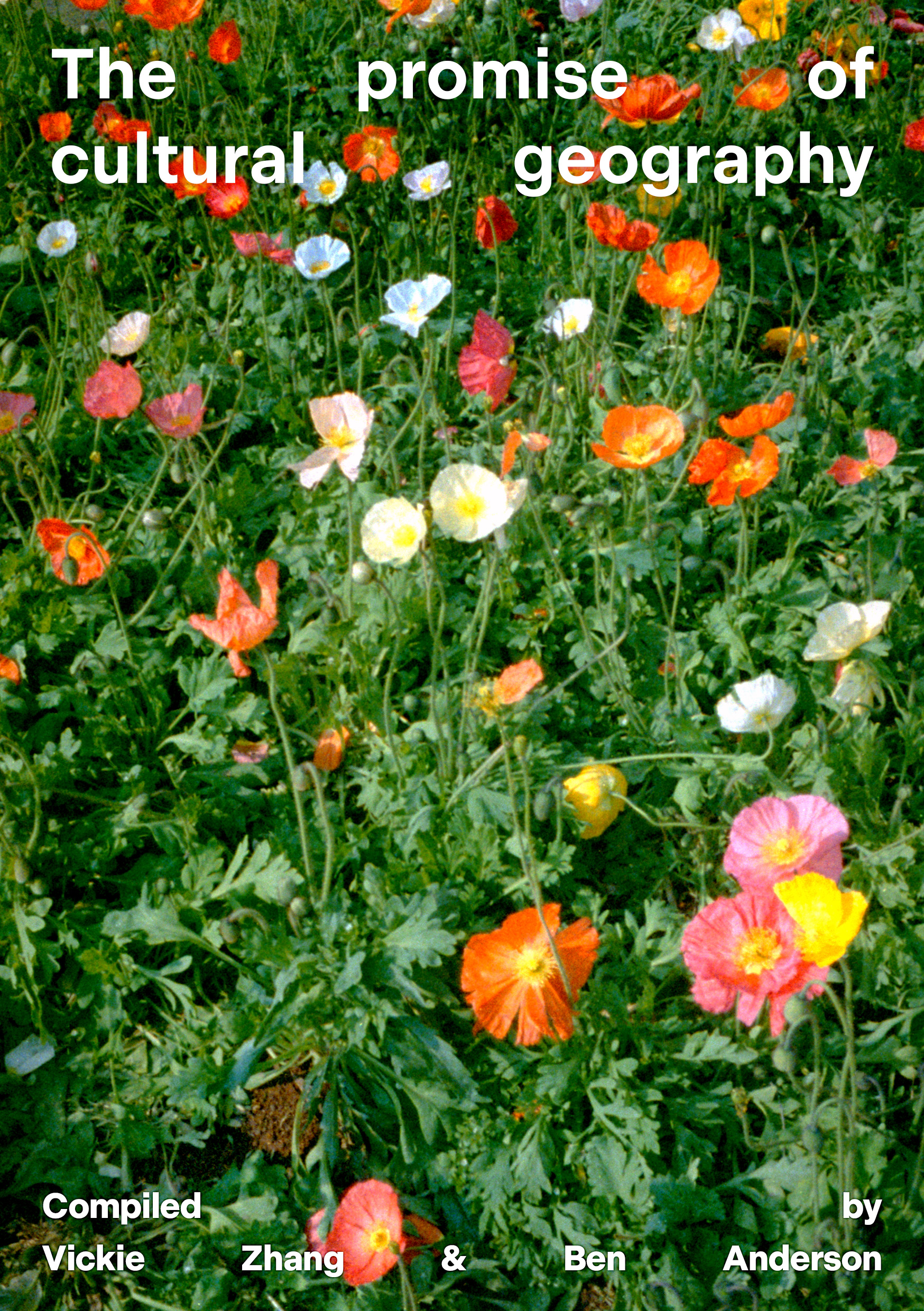
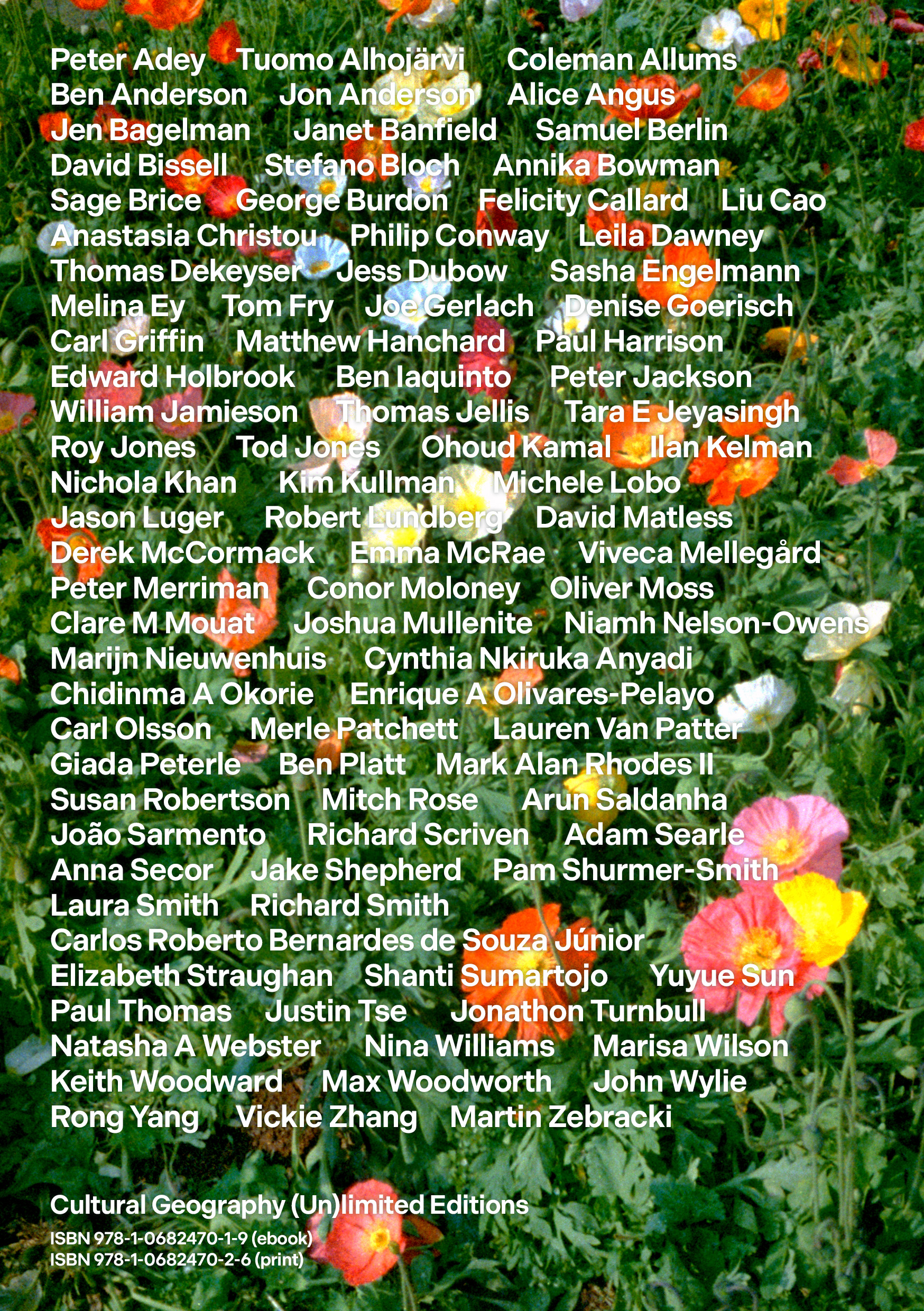
What somehow has come to feel like the main thing I’ve been working on throughout 2025 has been a side project with Ben Anderson up in Durham called The Promise of Cultural Geography, put out on our new publisher, Cultural Geography (Un)limited Editions, which we (frankly) established to put out the book (more on that in a future post...). The Promises project followed on from the 50th anniversary event for the RGS-IBG Social and Cultural Geography Research Group that I last wrote about, out of which Chris Philo and I wrote the Revisiting New Words, New Worlds correspondence piece.
To pair that ‘backwards-looking’ reflection, Ben and I hatched out a plan for a more ‘forwards-looking’ (or perhaps ‘stock-taking’) project, one that hoped to grasp at the multiplicty of the sub-discipline as it was being practiced in diverse corners and quarters of the world.
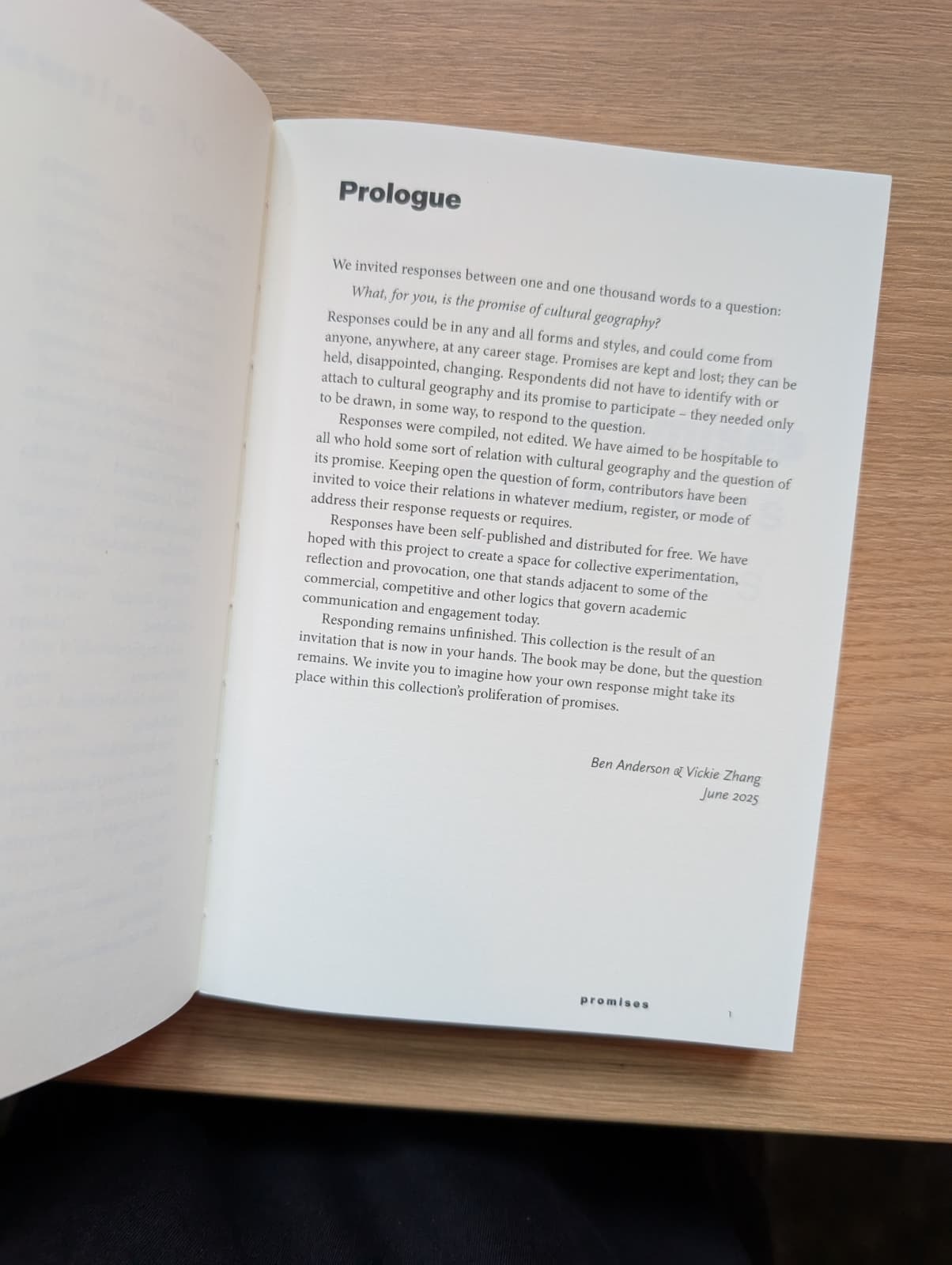
At the start of the year, we sent out an open call for single-word submissions of between 1 and 1,000 words, in any style or form, in response to the question ‘What, for you, is the promise of cultural geography?’
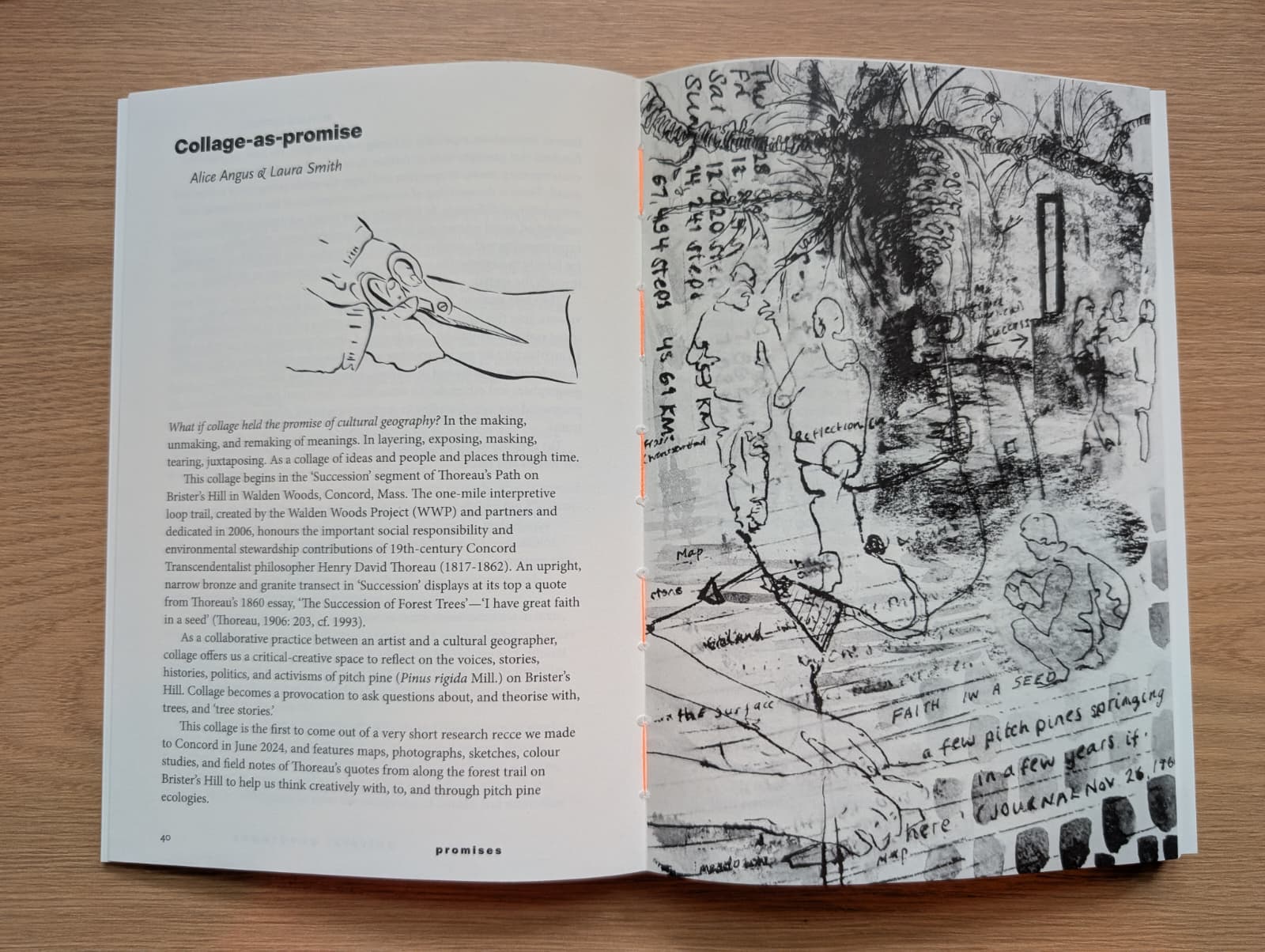
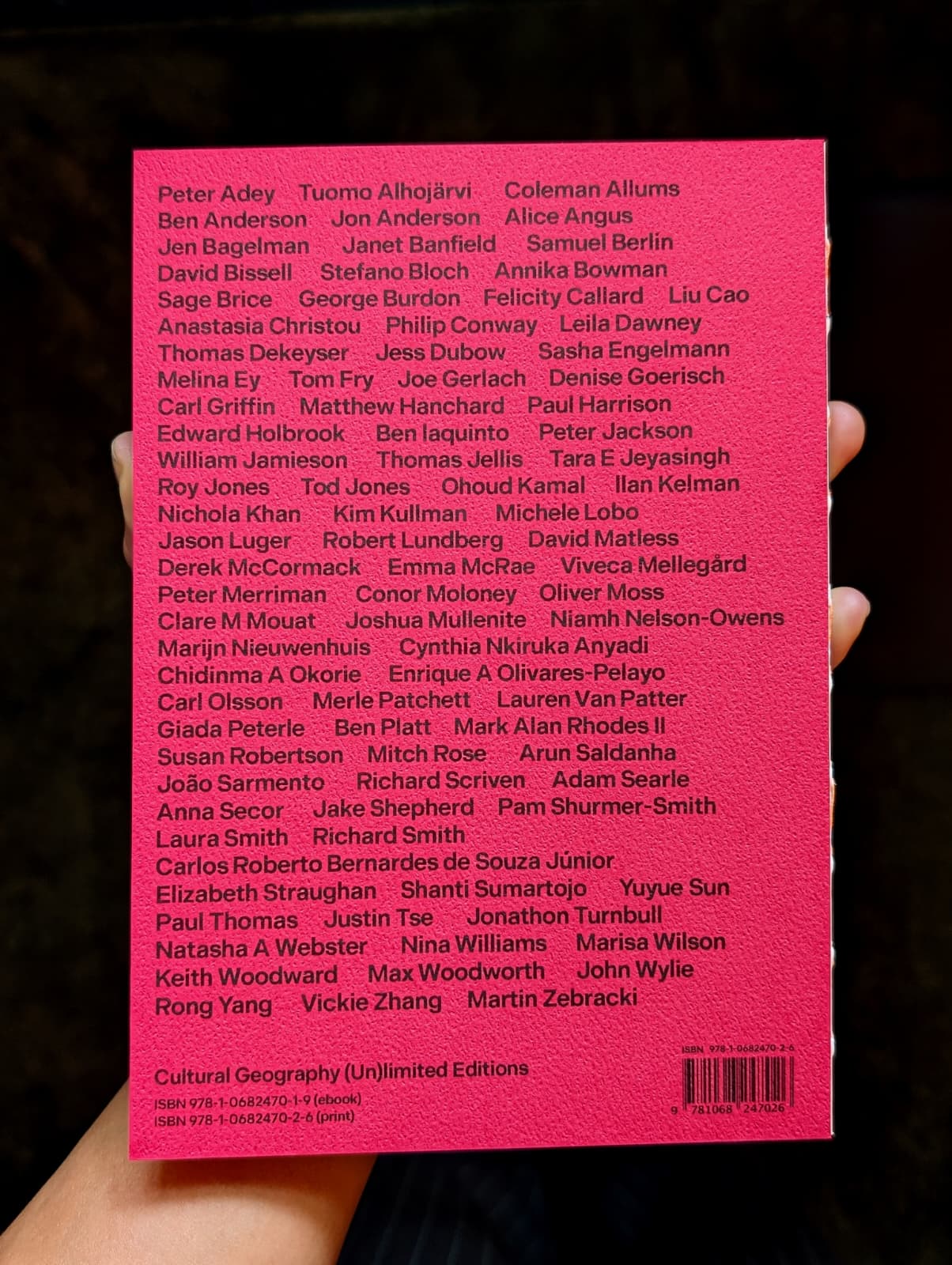
That call-out became Promises, a compilation of 86 single- and multi-authored entries responding to this perhaps rather engimatic question. (Indeed, I enjoyed chatting to my Chinese colleagues about how to translate the different meanings and connotations of the word ‘promise’, for which there is no single equivalent in Mandarin, including the sense of a pledge, an oath, a commitment, its directedness, futurity, uncertainty, even failure...)
In addition to the open-access digital copy (‘unlimited’), we also did a short run printed book (‘limited’), which we launched at the RGS-IBG Dialogues in Human Geography Discussion Forum ‘The future of cultural geography: promises and dreams’, alongside a stellar lineup of reflections and provocations by Adam Searle, Sasha Engelmann, Anna Secor, Leila Dawney and Chris Philo.
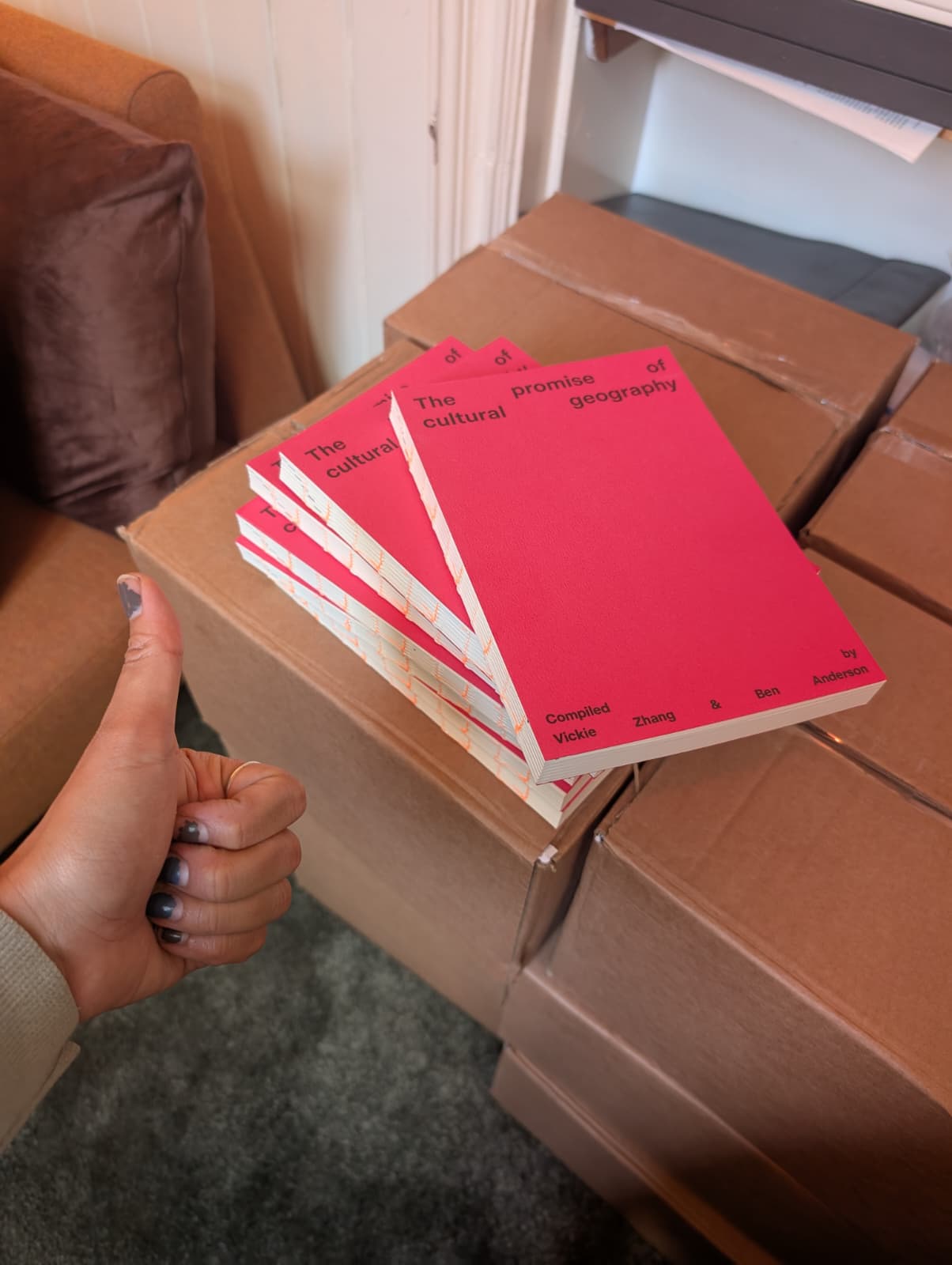
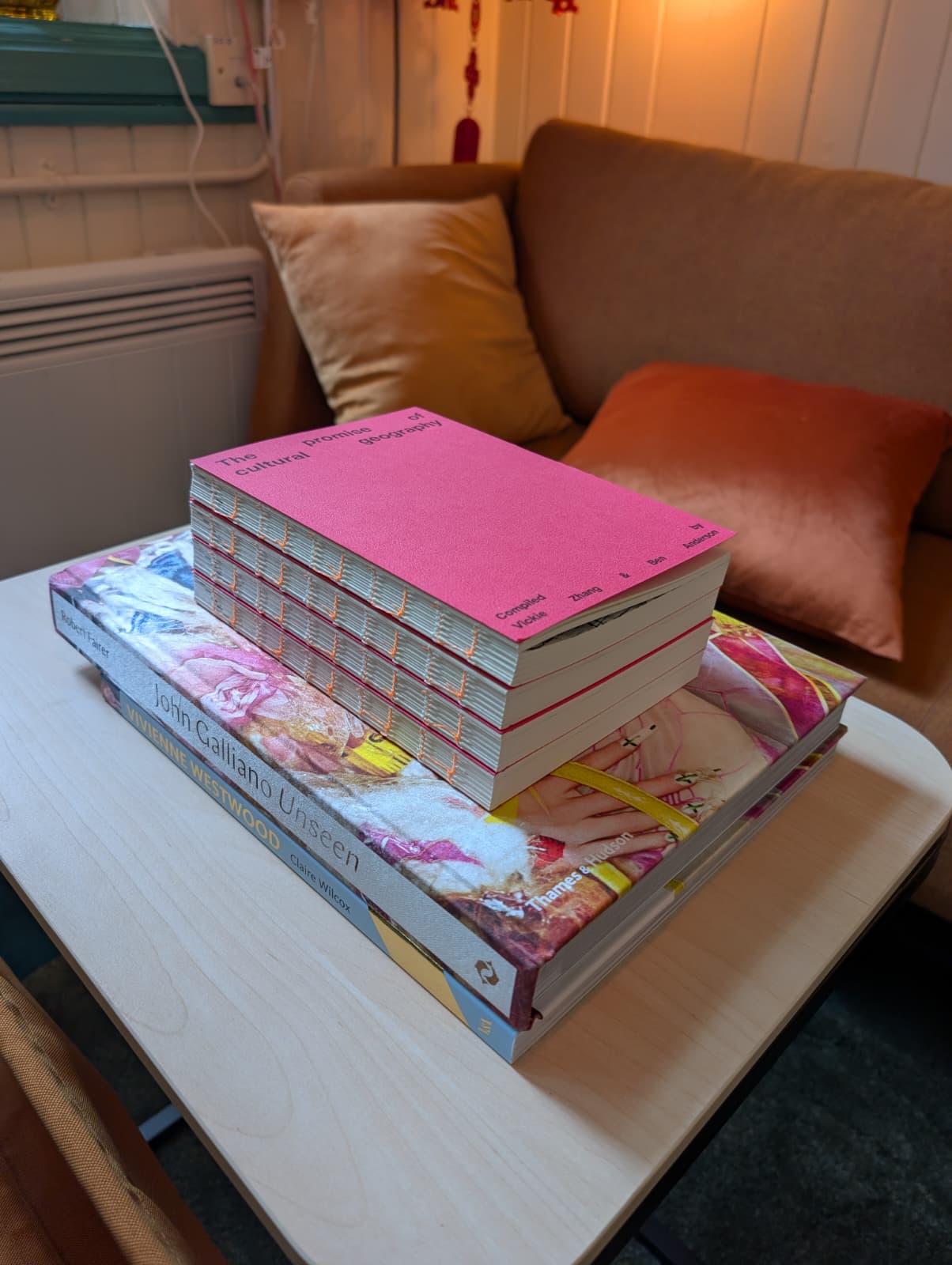
We were absolutely delighted to have the book beautifully printed by Gomer Press in Llandysul, Wales, with a embossed hot pink cover, textured cream paper, and a flurorescent-orange-stitched naked spine. Big props go to Merle Patchett for style tips on colours and textures for the print version.
Print copies are available for £10 + £3 postage worldwide — just get in touch with me by email if you’d like a copy. We managed to sell over 100 copies at the conference — a huge thanks goes to Catherine Souch and Sarah Evans of the RGS-IBG for taking care of the books at the registration desk.
If you’re interested in hearing more about the origins and unfoldings of the project, Ben and I recently joined a podcast about the project at the Channel, the podcast of the Institute of Asian Studies at the Universiteit Leiden. We were generously hosted by Ben Linder, who got in touch with us to learn more about the project. Ben asked some really banger questions, and it was an absolute delight to speak with him.
We are so grateful to every person who saw ‘promise’ in the Promise project. Ben and I are planning another collective project in the coming year, with much more planned for ‘cg(u)le’ — so stay tuned, and please, please consider sending something in! We’d love to have you.
What somehow has come to feel like the main thing I’ve been working on throughout 2025 has been a side project with Ben Anderson up in Durham called The Promise of Cultural Geography, put out on our new publisher, Cultural Geography (Un)limited Editions, which we (frankly) established to put out the book (more on that in a future post...). The Promises project followed on from the 50th anniversary event for the RGS-IBG Social and Cultural Geography Research Group that I last wrote about, out of which Chris Philo and I wrote the Revisiting New Words, New Worlds correspondence piece.
To pair that ‘backwards-looking’ reflection, Ben and I hatched out a plan for a more ‘forwards-looking’ (or perhaps ‘stock-taking’) project, one that hoped to grasp at the multiplicty of the sub-discipline as it was being practiced in diverse corners and quarters of the world.
At the start of the year, we sent out an open call for single-word submissions of between 1 and 1,000 words, in any style or form, in response to the question ‘What, for you, is the promise of cultural geography?’
That call-out became Promises, a compilation of 86 single- and multi-authored entries responding to this perhaps rather engimatic question. (Indeed, I enjoyed chatting to my Chinese colleagues about how to translate the different meanings and connotations of the word ‘promise’, for which there is no single equivalent in Mandarin, including the sense of a pledge, an oath, a commitment, its directedness, futurity, uncertainty, even failure...)
In addition to the open-access digital copy (‘unlimited’), we also did a short run printed book (‘limited’), which we launched at the RGS-IBG Dialogues in Human Geography Discussion Forum ‘The future of cultural geography: promises and dreams’, alongside a stellar lineup of reflections and provocations by Adam Searle, Sasha Engelmann, Anna Secor, Leila Dawney and Chris Philo.
We were absolutely delighted to have the book beautifully printed by Gomer Press in Llandysul, Wales, with a embossed hot pink cover, textured cream paper, and a flurorescent-orange-stitched naked spine. Big props go to Merle Patchett for style tips on colours and textures for the print version.
Print copies are available for £10 + £3 postage worldwide — just get in touch with me by email if you’d like a copy. We managed to sell over 100 copies at the conference — a huge thanks goes to Catherine Souch and Sarah Evans of the RGS-IBG for taking care of the books at the registration desk.
If you’re interested in hearing more about the origins and unfoldings of the project, Ben and I recently joined a podcast about the project at the Channel, the podcast of the Institute of Asian Studies at the Universiteit Leiden. We were generously hosted by Ben Linder, who got in touch with us to learn more about the project. Ben asked some really banger questions, and it was an absolute delight to speak with him.
We are so grateful to every person who saw ‘promise’ in the Promise project. Ben and I are planning another collective project in the coming year, with much more planned for ‘cg(u)le’ — so stay tuned, and please, please consider sending something in! We’d love to have you.
12/2025
![]()
![]()
Citation: Zhang, V., & Anderson, B. (2025). The promise of cultural geography. Cultural Geography (Un)limited Editions: Bristol and Durham. https://doi.org/10.71706/8dfd3ca0-0a6d-49ce-abdb-568a7ccbb807
Podcast about the project at ‘The Channel’, the podcast from IIAS at Leiden University: https://www.iias.asia/the-channel/promise-cultural-geography
![]()
![]()
![]()
![]()
![]()
Citation: Zhang, V., & Anderson, B. (2025). The promise of cultural geography. Cultural Geography (Un)limited Editions: Bristol and Durham. https://doi.org/10.71706/8dfd3ca0-0a6d-49ce-abdb-568a7ccbb807
Podcast about the project at ‘The Channel’, the podcast from IIAS at Leiden University: https://www.iias.asia/the-channel/promise-cultural-geography
Book — “Revisiting New Words, New Worlds: A Correspondence, June-September 2024”
Last November, Chris Philo and I put out a ‘correspondence’ in the form a small self-published book (seems impertinent to call it a book, but I suppose that’s an accurate description of the physical form it takes). The correspondence reflected on the early life of the Social and Cultural Geography Research Group (SCGRG) of the RGS-IBG and its role in the emergence of the influential ‘New Cultural Geography’ in the 1980s and 90s, specifically around the publication New Words, New Worlds published November 1991.
Several timelines converged and intertwined themselves early in 2024 to bring this project to life.
The earliest goes back to Chris examining my PhD thesis in early 2021. In the years since, we’ve kept in touch, and in the course of preparing lectures for an introduction to cultural geography unit as I started at Bristol, New Words, New Worlds kept cropping up in my reading - and yet, no matter where I looked, I couldn’t seem to find a copy. Seeing the Chris was the compiler, I got in touch to ask him about it.
When the 50th anniversary of the SCGRG came up (of which I’ve been Treasurer the last few years), Chris and I came up with the idea to make NWNW available again, to honour the role of the group in bringing the original publication together, and to put some contextualising words to the life NWNW has taken in the 33 years since.
To pull this together, Chris and I exchanged emails every few weeks for much of 2024. I loved receiving each thoughtful missive, and I’m thankful to Chris for taking the time to engage so wholeheartedly in this correspondence.
Last November, Chris Philo and I put out a ‘correspondence’ in the form a small self-published book (seems impertinent to call it a book, but I suppose that’s an accurate description of the physical form it takes). The correspondence reflected on the early life of the Social and Cultural Geography Research Group (SCGRG) of the RGS-IBG and its role in the emergence of the influential ‘New Cultural Geography’ in the 1980s and 90s, specifically around the publication New Words, New Worlds published November 1991.
Several timelines converged and intertwined themselves early in 2024 to bring this project to life.
The earliest goes back to Chris examining my PhD thesis in early 2021. In the years since, we’ve kept in touch, and in the course of preparing lectures for an introduction to cultural geography unit as I started at Bristol, New Words, New Worlds kept cropping up in my reading - and yet, no matter where I looked, I couldn’t seem to find a copy. Seeing the Chris was the compiler, I got in touch to ask him about it.
When the 50th anniversary of the SCGRG came up (of which I’ve been Treasurer the last few years), Chris and I came up with the idea to make NWNW available again, to honour the role of the group in bringing the original publication together, and to put some contextualising words to the life NWNW has taken in the 33 years since.
To pull this together, Chris and I exchanged emails every few weeks for much of 2024. I loved receiving each thoughtful missive, and I’m thankful to Chris for taking the time to engage so wholeheartedly in this correspondence.
3/2025
![]()
Citation: Philo, C. & Zhang, V. (2024). Revisiting ‘New Words, New Worlds’: A Correspondence. Social and Cultural Geography Research Group: Bristol. https://doi.org/10.71706/29b99027-6c3b-46ab-bf6b-54a74a746105
Learn more about the SCGRG 50th event and publication, and read the original New Words, New Worlds: https://scgrg.co.uk/50th

Citation: Philo, C. & Zhang, V. (2024). Revisiting ‘New Words, New Worlds’: A Correspondence. Social and Cultural Geography Research Group: Bristol. https://doi.org/10.71706/29b99027-6c3b-46ab-bf6b-54a74a746105
Learn more about the SCGRG 50th event and publication, and read the original New Words, New Worlds: https://scgrg.co.uk/50th
New paper — “Embodying industrial transitions: Melancholy loss, interrupted habit and transitional memory after the end of a coal mine“
After finally finding some time to write between moving from Singapore to Bristol, I’ve recently had a paper published in Transactions drawing on my PhD research on two coal mine closures in Australia and China.
The overall project aimed to trace the gamut of ways in which workers responded to the unwilled changes presented by the mine closures, exploring how people embodied the closure’s afterlife through changing circumstances, intensities and evaluations.
This particular paper presents a slice of this project that focuses on the slower-paced bodiy transformations afoot in everyday life, and the non-linear intensities associated with these melancholy transitions. It’s an attempt to show (what might be called) ‘non-representational’ and ‘representational’ forces as always imbricated in embodied life, through the plural operation of memory in unfolding experience. I use the term ‘affective transition’ to denote this transformative process, but something about the term is still unsatisfactory to me insofar as it suggests clear boundaries for a timespaces whose fuzzy edges necessarily reach across unremembered pasts, unassimilated presents and unrealised futures (as I argue in the paper). So the paradoxes remain.
I first wrote up these ideas during my PhD, so as a piece of work it feels old despite being newly out. I did enjoy coming back to the vignettes and smoothing out the original argument, but I think I’ve had enough of this more didactic academic writing style for the next while. In this version, I ended up grounding the narrative in the idea of ‘memory’ because I felt it resonated more widely, but I do think ‘melancholy’ really is the driving void at the heart of this paper - it’s an affective condition that keeps calling to me, and no doubt I’ll continue to grapple with it in the future.
After finally finding some time to write between moving from Singapore to Bristol, I’ve recently had a paper published in Transactions drawing on my PhD research on two coal mine closures in Australia and China.
The overall project aimed to trace the gamut of ways in which workers responded to the unwilled changes presented by the mine closures, exploring how people embodied the closure’s afterlife through changing circumstances, intensities and evaluations.
This particular paper presents a slice of this project that focuses on the slower-paced bodiy transformations afoot in everyday life, and the non-linear intensities associated with these melancholy transitions. It’s an attempt to show (what might be called) ‘non-representational’ and ‘representational’ forces as always imbricated in embodied life, through the plural operation of memory in unfolding experience. I use the term ‘affective transition’ to denote this transformative process, but something about the term is still unsatisfactory to me insofar as it suggests clear boundaries for a timespaces whose fuzzy edges necessarily reach across unremembered pasts, unassimilated presents and unrealised futures (as I argue in the paper). So the paradoxes remain.
I first wrote up these ideas during my PhD, so as a piece of work it feels old despite being newly out. I did enjoy coming back to the vignettes and smoothing out the original argument, but I think I’ve had enough of this more didactic academic writing style for the next while. In this version, I ended up grounding the narrative in the idea of ‘memory’ because I felt it resonated more widely, but I do think ‘melancholy’ really is the driving void at the heart of this paper - it’s an affective condition that keeps calling to me, and no doubt I’ll continue to grapple with it in the future.
2/2024
![]()
Citation: Zhang, V. (2024). Embodying industrial transitions: Melancholy loss, interrupted habit and transitional memory after the end of a coal mine. Transactions of the Institute of British Geographers. doi.org/10.1111/tran.12672

Citation: Zhang, V. (2024). Embodying industrial transitions: Melancholy loss, interrupted habit and transitional memory after the end of a coal mine. Transactions of the Institute of British Geographers. doi.org/10.1111/tran.12672
New paper — “What should we do with bad feelings? Negative affects, impotential responses”
Thomas Dekeyser, David Bissell and I have a new article out open access in Progress in Human Geography on the politics of ‘negative affects’.
We explore the ethics of responding to bad feeling in human geography, identifying an ‘ethics of rehabilitation’ which recurs across the discipline, that seeks to repair bad feeling through attempts to work away negativity and activate latent potential.
Against this persistent desire to overcome negativity and seek potential, we ask why, and how, geographers might explicitly make space for impotentiality. We outline two forms of impotentiality — incapacities (when one is unable to act) and negative capacities (when one decides not to act) — and draw on these positions to put forward an ‘ethics of impotentiality’ that, we suggest, might sidestep some of the more troubling effects of the rehabilitative position, and acknowledge the validity not only of bad feelings, but also the impotence that one might experience in the face of those overwhelming feelings.
Despite the topic matter, writing with these with these two irrepressibly brilliant and kind people was only full of good feels, and I’m looking forward to working with them again. We would love to hear your thoughts on the article if you find time to read it.
Thomas Dekeyser, David Bissell and I have a new article out open access in Progress in Human Geography on the politics of ‘negative affects’.
We explore the ethics of responding to bad feeling in human geography, identifying an ‘ethics of rehabilitation’ which recurs across the discipline, that seeks to repair bad feeling through attempts to work away negativity and activate latent potential.
Against this persistent desire to overcome negativity and seek potential, we ask why, and how, geographers might explicitly make space for impotentiality. We outline two forms of impotentiality — incapacities (when one is unable to act) and negative capacities (when one decides not to act) — and draw on these positions to put forward an ‘ethics of impotentiality’ that, we suggest, might sidestep some of the more troubling effects of the rehabilitative position, and acknowledge the validity not only of bad feelings, but also the impotence that one might experience in the face of those overwhelming feelings.
Despite the topic matter, writing with these with these two irrepressibly brilliant and kind people was only full of good feels, and I’m looking forward to working with them again. We would love to hear your thoughts on the article if you find time to read it.
12/2023
![]()
Citation: Dekeyser, T., Zhang, V., & Bissell, D. (2023). What should we do with bad feelings? Negative affects, impotential responses. Progress in Human Geography. doi.org/10.1177/03091325231213513

Citation: Dekeyser, T., Zhang, V., & Bissell, D. (2023). What should we do with bad feelings? Negative affects, impotential responses. Progress in Human Geography. doi.org/10.1177/03091325231213513